
Path3 Best Practices
Path3 is a fairly open-ended platform, offering the structure you need to organize your advertising based on your overall go-to-market strategy. However, a blank canvas can be really intimidating. Here are some best practices for organizing your Path3 account.
A quick orientation before we dig in. Your account is built in three layers: an Initiative is a goal aimed at a specific audience, it holds one or more Streams (the actual advertising working toward that goal), and each stream runs the individual ads. Most of the choices below come down to how you group audiences into initiatives and how you combine streams inside them.
Initiatives
An initiative should represent a unique combination of a goal or objective and an audience. Initiatives let you group streams together and measure their results as a whole. Any time your core audience or objective changes, split it into a new initiative. That way you can quickly see whether you’re hitting each goal in the dashboard and your exported metrics.
You build an initiative’s audience by mixing and matching three building blocks: Account Profiles (the kinds of companies you sell to), Personas (the people inside those companies), and Buyer’s Journey States (where a person is in their decision, from just becoming aware of a problem all the way to being ready to buy).
Most high-performing advertisers start with one initiative per Account Profile, then combine two Account Profiles into a single initiative when they’re so similar that splitting them isn’t worth it yet.
For example, you might divide your lead generation by account size, add an initiative to grow sales with existing channel partners, and top it off with an initiative that captures people already showing buying intent, aimed at specific stages of the buyer’s journey.
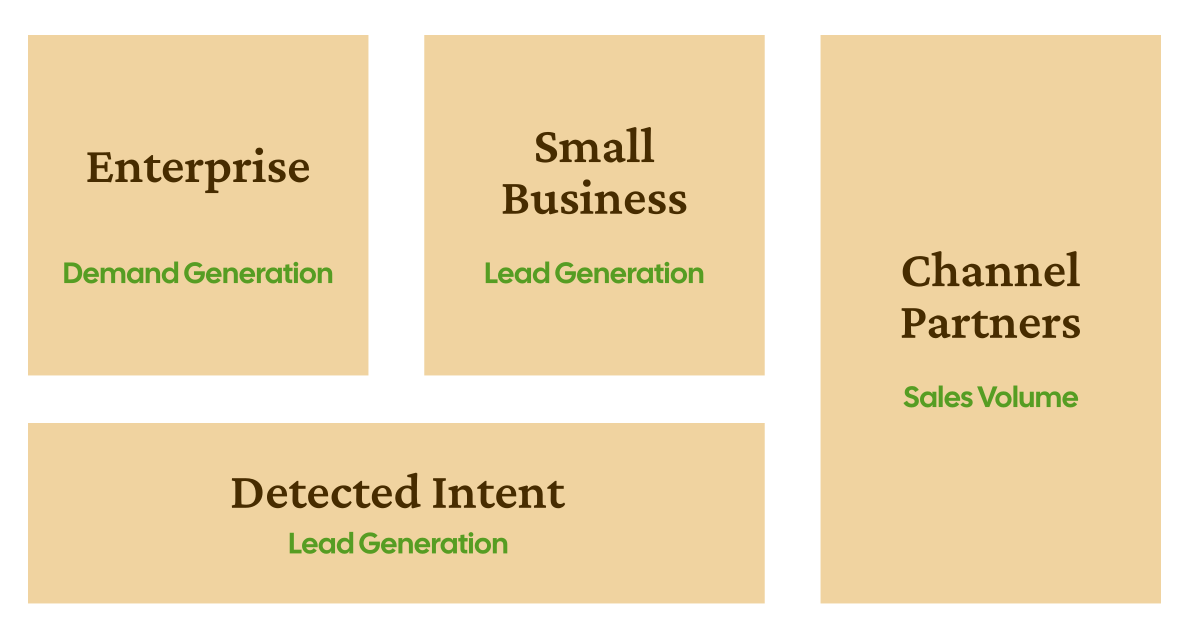
In this example, the advertiser targets multiple Account Profiles and multiple Personas within each initiative, but they all roll up to Enterprise, Small Business, and Channel. The Detected Intent initiative is a best practice for targeting stages of the buyer’s journey, because combining Buyer’s Journey State targeting with Account Profile or Persona targeting can leave you with streams too small to work well.
Rule of thumb: Organize your initiatives around how you want to measure where you’re winning and losing.
Whatever You Do, Don’t Build Initiatives by Solution
Resist the temptation to organize your initiatives by product or service line. Doing so puts too many ads in front of the same audience across multiple initiatives at once, and you’ll struggle to feed those streams with ads and landing pages that aren’t incredibly repetitive.
Even if your own results are measured product by product or service line by service line, structuring your ads that way is a recipe for disaster. Structure your initiatives around the audience and how you want to change that audience’s relationship with your brand. Then highlight the products or service lines you care about within the content and landing pages you promote inside those initiatives.
When to Split an Initiative
How many initiatives should you have? As few as you need to get the job done. Split an initiative into two only when one of these is true:
- Your strategic approach differs. You need a different set of streams to move a given Account Profile, Persona, or Buyer’s Journey State from its current relationship with your brand to the one you want.
- Budget must be split differently. When there isn’t enough money to go around, some group has to be deprioritized. Carving those audiences into their own initiative lets you fund them on purpose instead of by accident.
- The stakes or the measurement change. One enterprise account can be worth tens to thousands of small-business accounts. Audiences that different usually need to be measured separately so you can tell whether you’re winning.
Streams
A stream is a group of advertising inside an initiative, all working toward the same goal for the same audience. High-performing advertisers run several streams against the same audience at once to drive maximum performance.
How those streams work together depends on their scope — whether a stream is Open or Closed. Scope is a Path3 concept that decides how wide or how precise a stream’s targeting is:
- Open streams cast a wide net and let the ad platforms narrow in on the right people based on who engages. Good for finding new people you don’t already know.
- Closed streams target a known, precise audience and hit the same people repeatedly. Good for nurturing people you’ve already identified.
Open Streams
Because open streams may not hit the same person more than once with the same ad or offer, they don’t really layer, even when they target the same audience.
For that reason, it’s best to avoid brand advertising on open streams. Brand advertising relies on repeated exposure to the same message and visuals to have any impact.
Instead, focus open streams on catching the attention of people who match your target and converting them right away into a valuable prospect, in one of these ways:
- Turn them into a customer now with a low-cost, low-commitment offer you can upsell from later. Good destinations include online tools, playbooks and starter kits, or proprietary data and reports. (Leads or Sales stream)
- Capture their contact info to nurture by email and sync into your targeted audiences in Path3. Good destinations include webinars, assessments, product configurators, and courses. (Form Fills stream)
- Drive real engagement with educational content — as long as that content has strong calls to action built in, or is tagged as part of a Buyer’s Journey State you’re targeting elsewhere. (Education or Nurture stream)
Most initiatives have just a single open stream of one of the types above. For a really robust initiative, you might run two open streams of different types to chase different goals. For example, a monthly webinar (Form Fills) paired with a series of blog posts about problems your audience faces that your solution helps with (Education or Nurture).
Closed Streams
Unlike open streams, closed streams do reach the same audience over and over. So you can assume the same people are seeing a mix of all the closed streams targeting them every week.
This creates a 1 + 1 = 3 situation, where one stream lifts the performance of the others running alongside it.
High-performing advertisers often run all three of these closed streams inside each initiative, each adding value to the others:
- A Brand Advertising stream raises awareness, trust, and likeability through repeated exposure, and positions your brand in the buyer’s mind. The payoff is a higher engagement rate across every other stream, because the audience already recognizes and trusts you.
- An Education or Nurture stream drives traffic to (or video views of) content that helps the audience connect the problems they face with the solutions you offer. That might be product or service detail pages, a blog post that frames the problem, or a video telling a customer’s story. It builds your reputation as a thought leader while framing the buying decision in your favor.
- A Leads or Sales stream is the on-ramp to becoming a customer: a rotating set of offers, each a different way to start the sales process. That could be a time-boxed bonus for signing up or taking a meeting, or simply a new way to get started with your brand. Done well, these reinforce your brand while capturing the 1–5% of your audience that’s in market at any given time.
Stream types at a glance
| Stream type | What it’s for | Best used on |
|---|---|---|
| Brand Advertising | Build awareness, trust, and recall through repeated exposure | Closed |
| Education or Nurture | Connect the audience’s problems to your solution | Open or Closed |
| Leads or Sales | Give prospects a low-friction way to start buying | Open or Closed |
| Form Fills | Capture contact info to nurture later | Open |
A note on budget as you add streams
How you structure streams affects how your money gets spread. Path3 always sets aside a portion of every initiative’s budget for open streams so you keep reaching new people, and it funds your closed streams before topping up the open ones. Closed budget is then split evenly across your streams — so every closed stream you add spreads that budget a little thinner. The takeaway: add streams because they each earn their place in the mix, not just to have more of them.
Playbooks
The following playbooks outline advertising programs for common B2B scenarios. Mix and match them to build the exact set of initiatives you need to reach your goals across different audiences.
- Lead Generation by Size — generate leads from a market split into audiences by company size (for example, Enterprise vs. Small Business).
- Lead Generation by Industry (coming soon) — generate leads from a market split into audiences by industry or vertical.
- Channel Advertising (coming soon) — reach and activate dealers, distributors, resellers, and other partners in your sales channel.
- Strategic ABM (coming soon) — a focused, account-based marketing program aimed at a defined list of high-value target accounts.